Did Jesus Contradict Himself in John 2?
I was asked a really good question this week, and I thought I would expound on my answer a bit more than I could reply in a text message.
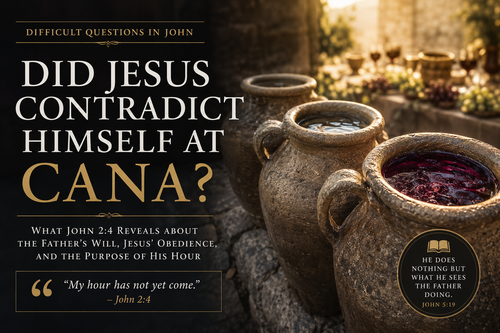
Did Jesus Contradict Himself at Cana?
One of the more difficult moments in John 2 occurs when Mary approaches Jesus at the wedding in Cana and says, “They have no wine.” Jesus responds, “Woman, what does this have to do with me? My hour has not yet come” (John 2:4). At first glance, the statement appears to be a refusal. Yet moments later, Jesus turns water into wine.
Did Jesus change His mind? Did Mary persuade Him to act? Or is something deeper taking place?
The answer lies not merely in the immediate context but in the broader theology of Scripture. John isn't presenting contradiction. He's revealing one of the defining characteristics of Christ's earthly ministry: the Son acts in perfect obedience to the Father and in accordance with the Father's appointed time.
The Meaning of "My Hour"
The phrase "my hour has not yet come" is one of the theological pillars of John's Gospel. Throughout the narrative, "the hour" consistently refers to Jesus' death, resurrection, exaltation, and glorification rather than simply the timing of an individual miracle.
John develops this theme deliberately. In John 7:30 and 8:20, Jesus' enemies are unable to arrest Him because "his hour had not yet come." Then the narrative shifts. In John 12:23, Jesus announces, "The hour has come for the Son of Man to be glorified." John 13:1 says Jesus knew "his hour had come to depart out of this world to the Father." Finally, in His High Priestly Prayer, Jesus declares, "Father, the hour has come; glorify your Son" (John 17:1).
Seen within this framework, Jesus' response to Mary isn't one of reluctance but of theological precision. He's announcing that His messianic mission will unfold according to the Father's timetable, not according to human expectation.
This principle didn't begin at Cana. Even at twelve years old, Jesus gently distinguished His Father's priorities from those of His earthly family. When Mary and Joseph found Him in the temple, He replied, "Did you not know that I must be in my Father's house?" (Luke 2:49).
Although He returned home and remained submissive to His parents (Luke 2:51), His ultimate allegiance was already clear. From the beginning, His life was ordered around His Father's mission.
The Father's Will Governs the Son
John repeatedly emphasizes that Jesus never acts independently of the Father.
"The Son can do nothing of his own accord, but only what he sees the Father doing" (John 5:19).
"I seek not my own will but the will of him who sent me" (John 5:30).
"I do nothing on my own authority" (John 8:28).
"The Father who sent me has himself given me a commandment" (John 12:49).
These statements form the theological backdrop for John 2. Jesus isn't declining Mary's request. He's clarifying that neither family relationships nor human expectations determine His ministry. Every word He speaks and every miracle He performs are expressions of His Father's will.
The Synoptic Gospels reinforce the same pattern.
In Mark 1:35–38, after an extraordinary day of healing, the disciples tell Jesus, "Everyone is looking for you." Rather than remaining where the crowds wanted Him, Jesus replied, "Let us go on to the next towns... for that is why I came." Popular demand didn't dictate His ministry.
Similarly, in Luke 4:42–44, the crowds begged Him to stay after witnessing His miracles. Instead, Jesus answered, "I must preach the good news of the kingdom of God... for I was sent for this purpose." Human need alone, not even His mother’s request, will determine His actions. His mission was governed by the Father's purpose.
This same principle reaches its climax in Gethsemane when Jesus prays, "Not as I will, but as you will" (Matthew 26:39). The obedience displayed at Cana ultimately leads to the obedience displayed at Calvary.
Paul later summarizes Christ's earthly ministry with remarkable simplicity: "He humbled himself by becoming obedient to the point of death, even death on a cross" (Philippians 2:8). John shows us what that obedience looked like. Paul explains its theological significance.
"What Does This Have to Do with Me?"
The Greek expression translated, "What does this have to do with me?" is ti emoi kai soi, literally, "What to me and to you?"
This idiom appears elsewhere in Scripture and typically marks a distinction in perspective, responsibility, or authority rather than hostility or disrespect.
Jesus isn't rejecting Mary. He's distinguishing her concern from His divine commission.
Mary sees an immediate social crisis. Jesus sees the unfolding plan of redemption. The miracle will happen, but it'll happen because the Father wills it…not because anyone has compelled the Son to act.
Why Does Jesus Call Mary "Woman"?
As I mentioned in the sermon, you and I will hear the word "Woman" as abrupt or disrespectful. In first-century Greek, however, the word gynai functioned as a courteous form of address, closer to "Madam" than to a harsh rebuke.
The clearest evidence comes later in John's Gospel. As Jesus hangs on the cross, He says to Mary, "Woman, behold, your son" (John 19:26). No reader would conclude that Jesus is dishonoring His mother while ensuring she would be cared for. The same respectful address appears at Cana.
What's changed isn't Jesus' affection for Mary but the nature of their relationship. As His public ministry begins, even His mother must relate to Him not primarily as her son but as the Messiah who lives in perfect submission to His Father.
This same truth appears elsewhere in the Gospels. When Jesus is told that His mother and brothers are waiting to speak with Him, He responds by pointing to His disciples and saying, "Whoever does the will of my Father in heaven is my brother and sister and mother" (Matthew 12:46–50). Jesus isn't diminishing His earthly family. He's redefining every relationship around the kingdom of God.
Mary's Remarkable Response
Perhaps the most overlooked detail in the passage is Mary's response.
She doesn't argue.
She doesn't insist.
She doesn't attempt to persuade Him further.
She doesn’t protest His usage of the word ‘woman’.
Instead, she simply tells the servants, "Do whatever he tells you."
Mary recognizes that the matter now rests entirely in Jesus' hands. She brings the need before Him and then entrusts both the timing and the solution to His sovereign wisdom.
Her response models genuine faith. Biblical faith presents its requests to Christ without attempting to govern His response.
The First Sign Points to the Final Hour
John concludes the account by saying that Jesus "manifested his glory, and his disciples believed in him" (John 2:11). The miracle itself wasn't the hour. It was a sign pointing toward it.
This is likely why John introduces the language of "the hour" at the very beginning of Jesus' public ministry. The first sign already anticipates the final sign. The abundance of wine at Cana foreshadows the greater provision that'll come through Christ's death and resurrection. The joy of the wedding feast points beyond itself to the blessings of the new covenant secured by His blood.
From Cana to Calvary, the Gospel moves along a single trajectory. Jesus is never manipulated by family.
He's never controlled by crowds.
He's never driven merely by immediate need.
He's never pressured by His enemies.
He's always governed by the Father's will.
Far from presenting a contradiction, John 2 provides one of the earliest and clearest windows into the identity of the incarnate Son. Jesus is compassionate, yet His compassion is always expressed through perfect obedience. He acts freely, sovereignly, and entirely according to the Father's purpose…not according to our purpose or desire.
The miracle at Cana isn't the story of a reluctant Messiah persuaded by His mother. It's the first public demonstration that the eternal Son has come to accomplish the Father's will…and every sign, every miracle, and every step He takes will move inexorably toward the hour for which He came.
If you've read this far, comment on the post and let me know if it helped you gain a deeper understanding of the text. If it is, I might continue a series on answering difficult questions in John.
Did Jesus Contradict Himself at Cana?
One of the more difficult moments in John 2 occurs when Mary approaches Jesus at the wedding in Cana and says, “They have no wine.” Jesus responds, “Woman, what does this have to do with me? My hour has not yet come” (John 2:4). At first glance, the statement appears to be a refusal. Yet moments later, Jesus turns water into wine.
Did Jesus change His mind? Did Mary persuade Him to act? Or is something deeper taking place?
The answer lies not merely in the immediate context but in the broader theology of Scripture. John isn't presenting contradiction. He's revealing one of the defining characteristics of Christ's earthly ministry: the Son acts in perfect obedience to the Father and in accordance with the Father's appointed time.
The Meaning of "My Hour"
The phrase "my hour has not yet come" is one of the theological pillars of John's Gospel. Throughout the narrative, "the hour" consistently refers to Jesus' death, resurrection, exaltation, and glorification rather than simply the timing of an individual miracle.
John develops this theme deliberately. In John 7:30 and 8:20, Jesus' enemies are unable to arrest Him because "his hour had not yet come." Then the narrative shifts. In John 12:23, Jesus announces, "The hour has come for the Son of Man to be glorified." John 13:1 says Jesus knew "his hour had come to depart out of this world to the Father." Finally, in His High Priestly Prayer, Jesus declares, "Father, the hour has come; glorify your Son" (John 17:1).
Seen within this framework, Jesus' response to Mary isn't one of reluctance but of theological precision. He's announcing that His messianic mission will unfold according to the Father's timetable, not according to human expectation.
This principle didn't begin at Cana. Even at twelve years old, Jesus gently distinguished His Father's priorities from those of His earthly family. When Mary and Joseph found Him in the temple, He replied, "Did you not know that I must be in my Father's house?" (Luke 2:49).
Although He returned home and remained submissive to His parents (Luke 2:51), His ultimate allegiance was already clear. From the beginning, His life was ordered around His Father's mission.
The Father's Will Governs the Son
John repeatedly emphasizes that Jesus never acts independently of the Father.
"The Son can do nothing of his own accord, but only what he sees the Father doing" (John 5:19).
"I seek not my own will but the will of him who sent me" (John 5:30).
"I do nothing on my own authority" (John 8:28).
"The Father who sent me has himself given me a commandment" (John 12:49).
These statements form the theological backdrop for John 2. Jesus isn't declining Mary's request. He's clarifying that neither family relationships nor human expectations determine His ministry. Every word He speaks and every miracle He performs are expressions of His Father's will.
The Synoptic Gospels reinforce the same pattern.
In Mark 1:35–38, after an extraordinary day of healing, the disciples tell Jesus, "Everyone is looking for you." Rather than remaining where the crowds wanted Him, Jesus replied, "Let us go on to the next towns... for that is why I came." Popular demand didn't dictate His ministry.
Similarly, in Luke 4:42–44, the crowds begged Him to stay after witnessing His miracles. Instead, Jesus answered, "I must preach the good news of the kingdom of God... for I was sent for this purpose." Human need alone, not even His mother’s request, will determine His actions. His mission was governed by the Father's purpose.
This same principle reaches its climax in Gethsemane when Jesus prays, "Not as I will, but as you will" (Matthew 26:39). The obedience displayed at Cana ultimately leads to the obedience displayed at Calvary.
Paul later summarizes Christ's earthly ministry with remarkable simplicity: "He humbled himself by becoming obedient to the point of death, even death on a cross" (Philippians 2:8). John shows us what that obedience looked like. Paul explains its theological significance.
"What Does This Have to Do with Me?"
The Greek expression translated, "What does this have to do with me?" is ti emoi kai soi, literally, "What to me and to you?"
This idiom appears elsewhere in Scripture and typically marks a distinction in perspective, responsibility, or authority rather than hostility or disrespect.
Jesus isn't rejecting Mary. He's distinguishing her concern from His divine commission.
Mary sees an immediate social crisis. Jesus sees the unfolding plan of redemption. The miracle will happen, but it'll happen because the Father wills it…not because anyone has compelled the Son to act.
Why Does Jesus Call Mary "Woman"?
As I mentioned in the sermon, you and I will hear the word "Woman" as abrupt or disrespectful. In first-century Greek, however, the word gynai functioned as a courteous form of address, closer to "Madam" than to a harsh rebuke.
The clearest evidence comes later in John's Gospel. As Jesus hangs on the cross, He says to Mary, "Woman, behold, your son" (John 19:26). No reader would conclude that Jesus is dishonoring His mother while ensuring she would be cared for. The same respectful address appears at Cana.
What's changed isn't Jesus' affection for Mary but the nature of their relationship. As His public ministry begins, even His mother must relate to Him not primarily as her son but as the Messiah who lives in perfect submission to His Father.
This same truth appears elsewhere in the Gospels. When Jesus is told that His mother and brothers are waiting to speak with Him, He responds by pointing to His disciples and saying, "Whoever does the will of my Father in heaven is my brother and sister and mother" (Matthew 12:46–50). Jesus isn't diminishing His earthly family. He's redefining every relationship around the kingdom of God.
Mary's Remarkable Response
Perhaps the most overlooked detail in the passage is Mary's response.
She doesn't argue.
She doesn't insist.
She doesn't attempt to persuade Him further.
She doesn’t protest His usage of the word ‘woman’.
Instead, she simply tells the servants, "Do whatever he tells you."
Mary recognizes that the matter now rests entirely in Jesus' hands. She brings the need before Him and then entrusts both the timing and the solution to His sovereign wisdom.
Her response models genuine faith. Biblical faith presents its requests to Christ without attempting to govern His response.
The First Sign Points to the Final Hour
John concludes the account by saying that Jesus "manifested his glory, and his disciples believed in him" (John 2:11). The miracle itself wasn't the hour. It was a sign pointing toward it.
This is likely why John introduces the language of "the hour" at the very beginning of Jesus' public ministry. The first sign already anticipates the final sign. The abundance of wine at Cana foreshadows the greater provision that'll come through Christ's death and resurrection. The joy of the wedding feast points beyond itself to the blessings of the new covenant secured by His blood.
From Cana to Calvary, the Gospel moves along a single trajectory. Jesus is never manipulated by family.
He's never controlled by crowds.
He's never driven merely by immediate need.
He's never pressured by His enemies.
He's always governed by the Father's will.
Far from presenting a contradiction, John 2 provides one of the earliest and clearest windows into the identity of the incarnate Son. Jesus is compassionate, yet His compassion is always expressed through perfect obedience. He acts freely, sovereignly, and entirely according to the Father's purpose…not according to our purpose or desire.
The miracle at Cana isn't the story of a reluctant Messiah persuaded by His mother. It's the first public demonstration that the eternal Son has come to accomplish the Father's will…and every sign, every miracle, and every step He takes will move inexorably toward the hour for which He came.
If you've read this far, comment on the post and let me know if it helped you gain a deeper understanding of the text. If it is, I might continue a series on answering difficult questions in John.
Posted in Difficult Questions
Recent
Archive
2026
January
February
March
April
May
July
September
No Comments