Why We Preach and Why It Matters
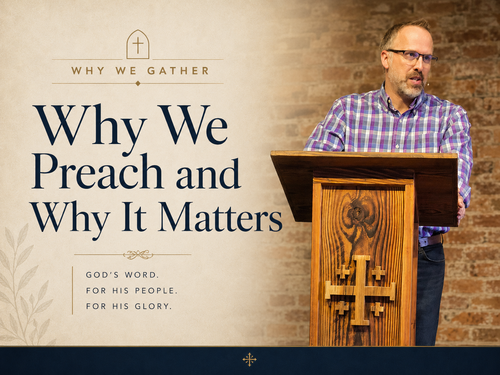
Every week, churches gather and give a significant portion (some more than others) of the service to a person standing in front of everyone else and talking. That can seem a little strange when you stop and think about it.
Why not spend more time singing? Why not have a group discussion? Why not just read the Bible together and move on? Why do we still devote so much time to preaching?
Some people think that pastors have very important opinions. Others gather because we need a weekly motivational speech. Some listen to preaching…because that’s just what you do.
None of those reasons really answers the question, “Why do we preach?” In short, we preach because God has spoken.
The Bible isn’t primarily a collection of human thoughts about God. It’s God speaking to us. Through Scripture, God reveals who He is, what He’s done, what’s gone wrong with the world, and how He’s acted to redeem sinners through Jesus.
That means the preacher’s job isn’t to invent a message. His task is to open the Scriptures, explain what they mean, and show how God’s truth speaks into our lives today.
Nehemiah 8:8 gives us a great picture of this. The people “read from the book, from the Law of God, clearly, and they gave the sense, so that the people understood the reading.”
Honestly, that’s still the heart of preaching. We read the Word, explain the Word, and help one another understand how we’re called to respond to the Word.
John Piper has described preaching as “expository exultation.” That phrase brings together two things that should never be separated.
Preaching should be expository. It should draw its message from the biblical text rather than using the Bible as a proof text for a pastor’s opinions and preferences.
But preaching should also involve exultation. The preacher isn’t just explaining facts about God like someone presenting information from a textbook. He’s proclaiming the beauty, holiness, grace, and glory of God.
The truth of Scripture is meant to lead us to worship!
We don’t stop worshiping when the singing ends. We worship as we hear God’s Word, see Christ more clearly, repent of sin, receive grace, and respond with faith.
But preaching has to do more than give us accurate information. It also has to give us the gospel.
Bryan Chapell has often warned against preaching that leaves people with little more than, “Try harder. Do better. Be more disciplined.” The Bible certainly tells us how to live. It confronts our sin, corrects our thinking, and calls us to obedience. But Christian preaching can’t begin and end with what we should do. It first has to announce what God has done.
Jesus lived the life we’ve failed to live. He died the death our sin deserved. He rose on the third day, and He now offers forgiveness, righteousness, and new life to everyone who trusts in Him.
Grace comes before obedience. We don’t obey so that God will accept us. In Christ, we’re accepted by grace, and that grace begins to transform the way we live.
That’s why faithful preaching should always lead us beyond self-improvement and toward Jesus. We don’t simply need better habits. We need a Savior.
Preaching also carries a certain seriousness. Richard Baxter is one of my favorite Puritan writers, and he understood this deeply. He didn’t treat preaching like an academic exercise or a performance. He preached with the conviction that pastors were addressing real people whose souls mattered eternally.
That doesn’t mean preaching should be manipulative, angry, or unnecessarily dramatic. It means the preacher should recognize the weight of what he’s doing.
He’s speaking to people who are suffering, doubting, wandering, grieving, sinning, and searching. Some need to be comforted. Some need to be confronted. Some need to be reminded of grace. Some may need to hear the gospel for the first time.
The pastor also preaches to himself first and foremost. He isn’t above the congregation as the master of Scripture. He stands alongside them as a fellow sheep in God’s flock…someone who needs to be corrected, encouraged, forgiven, and changed.
And those who listen have a responsibility too. We shouldn’t come to a sermon asking only, “Was that interesting?” or “Did I enjoy it?”
Better questions are:
What did this passage show me about God?
What did it reveal about my own heart?
How did it point me to Christ?
What truth do I need to believe?
What sin do I need to confess?
What step of obedience is God calling me to take?
We should listen carefully and thoughtfully, testing what we hear against Scripture. The authority isn’t found in the preacher's personality. It’s found in the Word he’s called to proclaim.
We preach because God has spoken.
We preach because Christ must be proclaimed.
We preach because truth should awaken worship.
We preach because grace, not guilt, transforms people.
And we preach because God still uses His Word to create faith, comfort the broken, confront sin, strengthen His church, and send His people into the world.
The preacher isn’t the point of preaching.
Jesus is.
Posted in Why We Gather
Recent
Archive
2026
January
February
March
April
May
July
September
No Comments